
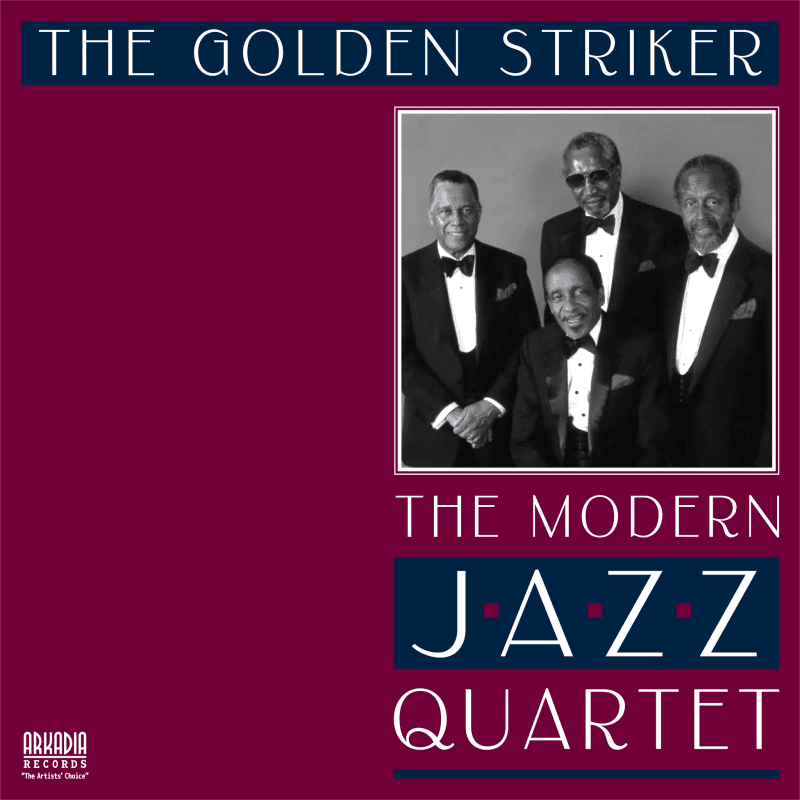
MJQ: The Golden Striker showcases the Modern Jazz Quartet’s unique ability to blend jazz improvisation with classical form. Featuring a collection of John Lewis compositions performed with the Kammerorchester Arcata Stuttgart, the album pairs the richness of a chamber orchestra with MJQ’s trademark precision, lyricism, and ensemble conversation.
At the center of the album is Lewis’s remarkable gift for musical storytelling. The title composition, “The Golden Striker,” was inspired by the bronze figures that strike the bells atop Venice’s famous clock tower in Piazza San Marco. Built on a steady, percussive pulse, the piece translates motion into music, with Milt Jackson’s luminous vibraphone and Lewis’s measured piano lines creating one of MJQ’s most recognizable works.
“A Day in Dubrovnik,” unfolds as a three-part suite inspired by Lewis’s visit to the historic Croatian city. The suite journeys over the course of a day, moving from bright, animated passages to darker, more spacious moods before settling into a quiet reflection, demonstrating the Quartet’s ability to sustain a musical narrative across a larger canvas. Throughout the performance, Jackson’s expressive vibraphone, Percy Heath’s resonant bass, and Mickey Roker’s sensitive drumming bring warmth and motion to Lewis’s carefully crafted compositions.
Recorded live in Germany during the group’s 40th Anniversary celebration, MJQ: The Golden Striker captures the Modern Jazz Quartet’s unique achievement: a seamless blend of jazz improvisation, classical form, and ensemble precision. More than a concert recording, it is a portrait of four master musicians creating music of extraordinary grace, depth, and imagination.
Song Selection:
- Alexander’s Fugue – 05:26
- The Golden Striker – 07:59
- Adagio from Concierto de Aranjuez – 11:01
- Three Windows (from “No Sun in Venice”) – 03:51
- A Day in Dubrovnik Suite – 17:12
- The Golden Striker (from “No Sun in Venice”) – 03:43
- Adagio from Concierto de Aranjuez – 05:01
John Lewis: Piano
Percy Heath: Bass
Milt Jackson: Vibes
Mickey Roker: Drums
String Orchestra: Kammerorchester Arcata
About the Modern Jazz Quartet:
American musical ensemble noted for delicate percussion sonorities, innovations in jazz forms, and consistently high-performance standards sustained over a long career. For most of its existence the group was composed of Milt Jackson (original name Milton Jackson; January 1, 1923, Detroit, Michigan, U.S.—d. October 9, 1999, New York, New York), vibes; John Lewis (in full John Aaron Lewis; May 3, 1920, La Grange, Illinois, U.S.—d. March 29, 2001, New York, New York), piano; Percy Leroy Heath (April 30, 1923, Wilmington, North Carolina, U.S.—d. April 28, 2005, Southampton, New York), bass; and Connie Kay (original name Conrad Henry Kirnon; April 27, 1927, Tuckahoe, New York, U.S.—d. November 30, 1994, New York), drums.
Jackson, Lewis, and drummer Kenny Clarke were pioneer bop musicians who had played together in the 1948 Dizzy Gillespie big band and pursued separate careers before adding Heath to form the Modern Jazz Quartet in 1952. Its early career was distinguished by introducing Lewis compositions such as “Django” and “Concorde.” Clarke’s departure in 1955 resulted in a loss of some of the group’s rhythmic energy; his replacement was Kay, whose playing helped place the interplay of Jackson and Lewis in the foreground. Jackson, whose dynamic sensitivity and technical mastery brought a rare expressive quality to his instrument, was a virtuoso of melody, rhythmic detail, and swing. Lewis accompanied him not with the customary harmonic punctuations but rather with riffs (repeated melodic patterns) and melodic variations in a rhythmically simplified style that resulted in unique extended counterpoint; Heath, an uncommonly melodic bassist, and Kay accompanied.
Lewis’s interest in baroque forms led him to compose fugues for the MJQ, and his classical-music-inspired works such as The Comedy (1962) and the film score No Sun in Venice (1957) are among the group’s successes. Popular and jazz standards and Jackson’s compositions were also part of its repertoire; in the 1980s it played, less successfully, arrangements of Duke Ellington compositions. In its album Third Stream Music (1957) the MJQ is joined by a string quartet and others in extended works by jazz and classical composers.
Its members also pursued separate careers during periods when the MJQ was not performing together, and in 1974 it disbanded. It began reuniting for annual tours in the 1980s. Following Kay’s death in 1994, Albert (“Tootie”) Heath, brother of Percy, became the MJQ’s drummer.

 English
