
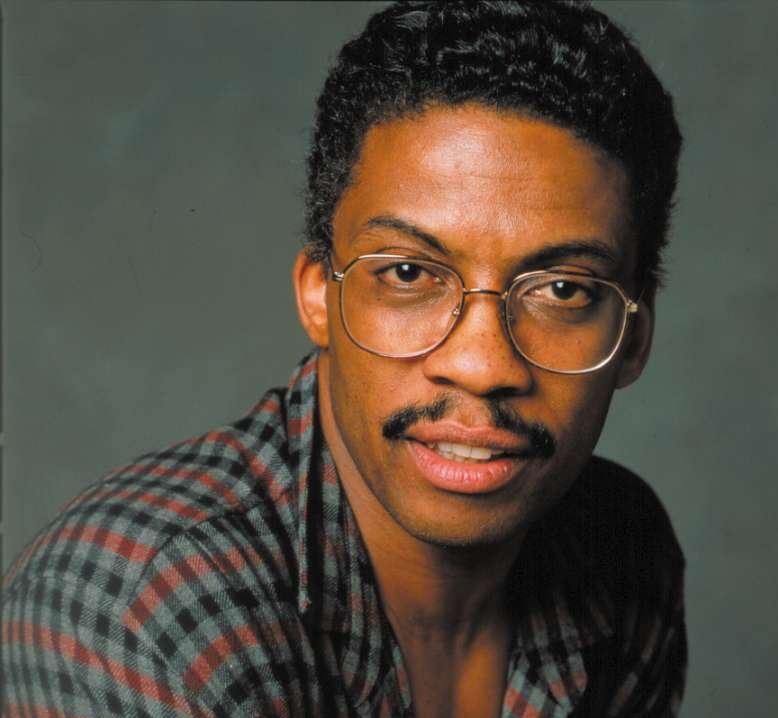
Herbie Hancock’s talent as a pianist was evident when, at age 11, he performed Mozart’s D Major Piano Concerto with the Chicago Symphony Orchestra. He began playing jazz in high school, initially influenced by Oscar Peterson and Bill Evans. Also at this time, a passion for electronic science began to develop, so Hancock studied both electrical engineering and music composition at Grinnell College in Iowa. His love of electronics led Hancock to be a pioneer in the use of electric piano, clavinet, and synthesizer in jazz.
In 1961, trumpeter Donald Byrd asked the young pianist to join his group in New York, leading to Blue Note offering him a recording contract. His first album as leader, Takin’ Off, which included the hit single “Watermelon Man,” demonstrated a gift for composition and improvisation. His talent impressed Miles Davis enough to ask Hancock to join his band in 1963. In the five years he worked with Davis, who became a mentor as well as an employer, Hancock established his standing as one of the greatest pianists of all time. Along with Ron Carter (bass) and Tony Williams (drums), Hancock altered the role of the rhythm section in jazz to include expanded solos and spontaneous changes in mood and tempo. He also composed a number of pieces for the band as well as for his outstanding solo recordings with Blue Note. It was toward the end of his tenure with Davis that he began to use electric piano.

After leaving the band in 1968, Hancock continued to explore the use of electronic instruments in his music. In 1973, he formed a quartet whose first recording, Head Hunters, launched him into jazz stardom and became a bestselling jazz album. In the late 1970s, Hancock revived the old Miles Davis band (Freddie Hubbard stood in for Davis) under the name V.S.O.P. and they toured extensively. Throughout his career, he has demonstrated stunning artistic versatility. In 1983, “Rockit,” a single that resulted from a collaborative effort with the rock band Material, became a hit on MTV. Hancock then switched gears completely, partnering with Gambian kora virtuoso Foday Musa Suso on two albums, Village Life and Jazz Africa. He also has written scores for several films, including Blow-Up in 1966, Death Wish in 1974, and Round Midnight, for which he won an Academy Award in 1987.
Hancock continues to work as a producer and in both the electric and acoustic spheres of jazz. In 2008, he won the Grammy Album of the Year for River: The Joni Letters, the first jazz album to win that award in 43 years.

 English
